Why are some crystals attractive to us and others not?
Written by: Echipa Druzy
|
|
Time to read 9 min
Why do some crystals attract us?
Certain crystals attract us because their shape, color, and geometric structure can resonate with our inner state at that moment. Crystals have an extremely orderly atomic structure, and this order can create a sense of balance or harmony for those who look at or use them. That's why people often feel instinctively drawn to certain stones at different times in their lives.
There are moments in life when a crystal seems to attract us inexplicably. We enter a space filled with stones and minerals, our gaze passes over dozens of colors and shapes, and suddenly one of them seems to call us.
It is not necessarily the rarest or the most spectacular. Yet, something inside us responds.
Many people say that at that moment "the crystal chooses them." But if we look closer, perhaps things work the other way around: something inside us recognizes in the energy of that stone a familiar or necessary frequency.
This encounter can take place in a crystal shop, in a mineral collection, or even in a quiet moment at home when we look at pictures of stones online and find ourselves repeatedly drawn to the same stone.
Sometimes we don't even know why.
The world of crystals is incredibly vast. From stones known for thousands of years to minerals discovered relatively recently, each crystal seems to carry its own story. We have gathered in the following guide some of the most well-known and beloved crystals - Top 12 Most Known Semi-Precious Stones and Crystals.
Photo credit: Unsplash
Why are we attracted to certain crystals and not others? In this article, we explore the subtle connection between our inner energy, the geometric structure of crystals, and the colors that instinctively influence us. Sometimes, a crystal seems to "call" us – and the explanation may be deeper than the simple beauty of the stone.
1. A memory from Barcelona
I perfectly remember such a moment in a small crystal shop in Barcelona.
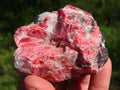
On a table were several pieces of jewelry with semi-precious stones, and among them was a ring with rhodochrosite. It wasn't the largest, nor the most dazzling. But it had a deep pink color, crossed by those delicate stripes that seem almost painted by nature.
I looked at it for a long time. I put it on my finger. I turned it in the light. For a few minutes, I had the feeling that this ring was telling me a story I didn't yet understand.
I didn't buy it...
Four years have passed since then. In the meantime, many rhodochrosite rings have passed through my hands – some perhaps rarer or more spectacular. And yet, none seemed as fitting as that ring.
It's strange how some crystals remain in memory long after we've seen them, as if a part of us stayed connected to that moment.
It wasn't just the color of the stone. It was the way it was drawn. The play of those pink bands, almost like delicate waves, which seemed to create a perfect harmony inside the crystal.
Sometimes I think it wasn't just its beauty. Perhaps that structure, that natural geometry of the stone, matched perfectly with something inside me at that moment in life — maybe with the need to find a perfect balance between giving and receiving.
Rhodochrosite is considered by many to be a stone of the heart and emotional balance. If you want to discover the natural forms of this stone, you can explore our collection of rhodochrosite.
2. The resonance between our inner world and the order of crystals
Perhaps the attraction we feel towards certain crystals is related to something much more subtle than their mere beauty.
Each of us carries within layers of experiences, emotions, and beliefs accumulated over a lifetime. Some are conscious, others remain deep in the mind, almost forgotten. There are parts of us that we have built over time, but also parts that, sometimes unknowingly, we have left behind.
All these layers shape the way we perceive the world and create, in a subtle way, what we might call a certain inner frequency.
In ancient traditions, this subtle connection between man and mineral is described in what we today call crystal therapy, an ancient practice that explores the relationship between energy, consciousness, and the structure of crystals.
At the same time, crystals are some of the most perfect forms of order in nature. At a microscopic level, their atoms are arranged in a stable geometric lattice, forming what mineralogy calls crystalline systems: cubic, hexagonal, orthorhombic, monoclinic, triclinic, or trigonal.
For example, quartz crystallizes in the trigonal system, forming those elegant prisms ending in perfectly symmetrical points. This natural geometry was formed deep within the Earth, sometimes over millions of years.
When looking at a crystal, we only see its surface. But inside, there is an extremely precise mathematical structure, an order that has remained stable for entire geological ages.
Perhaps it is precisely this order that sometimes attracts us so strongly. Because when a crystal enters our space — whether we hold it in our palm, wear it as jewelry, or have it nearby — its stable structure can act as a kind of silent model of harmony.
Not because it produces miraculous changes, but because sometimes a perfectly organized structure reminds us, on a deep level, of the balance we seek within ourselves.
And perhaps it is in this discreet encounter between the order of the crystal and the complexity of our inner world that the sensation we simply call attraction arises.
Source: Unsplash
3. Geometry that Instinctively Attracts Us
The shapes of crystals are not random. They follow precise rules of nature: triangles, hexagons, prisms, pyramids.
These shapes frequently appear in what we call sacred geometry – patterns found everywhere in nature, from the structure of snowflakes to the arrangement of a flower's petals.
The human mind seems to instinctively recognize these patterns. That's why certain mineral shapes fascinate us so much. It's not just beauty, but also a subconscious recognition of a universal order.
When we look at a quartz geode, a natural pyramid, or a perfect crystallization, our eye perceives more than just a simple stone. It perceives a form of harmony.
And when we begin to explore this fascinating world, the question of authenticity inevitably arises — a subject we have written about in more detail in our guide on how to identify authentic semi-precious stones.
Photo credit: Unsplash
4. Why certain colors attract us
Besides form and structure, color is often the first thing that attracts us.
Interestingly, this attraction doesn't always remain the same. Throughout life, we notice that we are drawn to certain colors during certain periods, and after a few years, preferences can change completely.
Sometimes the gaze instinctively seeks calm and deep tones – the violet of amethyst or the blue of lapis – as if the mind needs peace and clarity.
Other times we are attracted to dense and dark stones, like black tourmaline. Not coincidentally, these crystals have long been associated with the idea of stability and grounding. In turbulent periods of life, when everything seems to move too fast, our eye may instinctively seek those solid mineral forms that convey a sense of weight, safety, and anchoring.
These choices may be more than just simple aesthetic preferences.
The colors and structure of the crystals can become a reflection of the balance we seek at that moment.
In this sense, a crystal that attracts us can sometimes function as a kind of symbolic bandage over an inner area that needs attention.
Not because the stone would make the change in our place. The power of transformation always belongs to the person.
But sometimes the perfect structure of a crystal, its color, or the way it reflects light can become a silent reminder of a state we want to rediscover.
Maybe tranquility. Maybe courage. Maybe balance.
6. Crystals that remain in our memory
Perhaps that is why some crystals remain in our memory for years.
Not because they are rare or spectacular, but because, at a certain moment in life, they touched an invisible chord within us.
Sometimes we buy them and they become part of our life – a ring worn daily, a stone kept on the desk, or a crystal that stays on the nightstand for years.
Other times we don't take them with us. And yet they remain in our story.
Sometimes they appear just to show us, for a moment, a form of harmony that we are ready to recognize within ourselves. ✨
👉 If you want to explore natural crystals that might intuitively attract you, discover our collection of crystals and semi-precious stones.
FAQ - Frequently asked questions about attraction to crystals
1. Why do I feel that a certain crystal attracts me more than others?
Many people notice that when they look at multiple crystals, one of them seems to stand out. This attraction can have several explanations: the color, shape, texture, or simply the way that stone resonates with the inner state at that moment. Sometimes we instinctively choose crystals that reflect the balance or state we need.
2. Is it possible for a crystal to "choose us"?
The expression is rather poetic. In reality, what happens is that we recognize something familiar in that crystal — either through its color, shape, or symbolism. It is an intuitive reaction, not necessarily a rational one.
3. Why do I always return to the same stone, even when I see it online?
This happens more often than we think. Sometimes we look at a photo of a crystal, leave, but then return to it again. This repeated return may be a sign that that shape, color, or structure attracts us in a deeper way than we initially realize.
4. Do crystals have an energy that influences us?
Crystals are extremely orderly natural structures. In mineralogy, they are formed from stable geometric networks, sometimes millions of years old. Some people believe that this stability can have a subtle effect on our inner state, especially when we use crystals as symbols for intention, reflection, or balance.
5. Why does the preference for certain crystals change over time?
As we go through different stages of life, our inner states also change. That is why it is possible that, during one period, we are attracted to calming crystals, while in another period to stones that convey stability or energy. The choice of crystals often reflects the moment we are in.
6. What does it mean if a crystal stays in my memory for a long time?
Sometimes we encounter a crystal that we do not purchase, but which remains in our memory for years. This is not uncommon. Some crystals seem to mark a moment in our life or an inner state that we recognize later.
Articles about crystals, zodiac signs, and semi-precious stones:
If you are interested in crystals associated with astrology and their symbolism, discover the articles below about zodiac signs, semi-precious stones, and the energy of crystals.
✍️ About the author: Article written by the editorial team druzy.eu – enthusiasts of crystals, minerals, and their ancient stories. All information is carefully researched to provide you with an authentic and profound experience.